
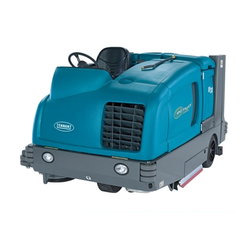
Disk vs. Cylindrical vs. Orbital Floor Scrubbers
Quick answer
Choose disk for everyday scrubbing of smooth floors when budget matters most. Choose cylindrical to skip pre-sweeping on rough, grouted or debris-strewn industrial floors. Choose orbital for mixed surfaces, cleaning into corners and chemical-free finish stripping.
Shop walk-behind scrubbersShop rider scrubbers Not sure? Call 800-440-6723 or get a recommendation.
Two machines with the same tank size and footprint can clean very differently depending on the scrub head. Each design applies cleaning energy to the floor in a different way, and each has a clear sweet spot. For a broader overview, see our Automatic Scrubbers Buyer's Guide.

At a glance
| Disk | Cylindrical | Orbital | |
|---|---|---|---|
| Motion | Rotation, 140 to 300 RPM | Counter-rotating tubes, about 3× disk speed | Micro-oscillation, about 2,200 RPM |
| Head shape | Round | Two long tubes | Rectangular |
| Picks up debris | No | Yes (into hopper) | No |
| Pads or brushes | Both | Brushes only | Pads only |
| Down pressure | High | Lower | High (via vibration) |
| Chemical-free stripping | No | No | Yes |
| Best floor type | Smooth, flat | Textured, debris-heavy | Mixed surfaces, grouted tile |
| Typical industries | Healthcare, retail, education | Industrial, food & beverage, parking | Multi-surface facilities, refinishing-heavy operations |
1. Disk scrubbers

Counter-rotating disk brush motion
The most traditional and most common scrub head design. One or two flat, round pads or brushes spin horizontally and apply firm down pressure to the floor. Cleaning solution is dispensed through the center of the discs.
Motion: rotation, 140 to 300 RPM · Head: round · Accessories: pads or brushes
Best for
Smooth, flat floors such as VCT, sheet vinyl, polished concrete and terrazzo, in facilities where pre-sweeping is already part of the routine. Common in healthcare, education, retail and office environments.
Strengths
- Highest down pressure for tough soils and stains
- Lower initial cost and simpler maintenance
- Long-lasting brushes; wide pad selection
- Can be used to strip floor finish
Trade-offs
- No debris pickup; floors must be swept first
- Round head leaves uncovered area at corners and edges
- Less effective on textured or grouted surfaces
2. Cylindrical scrubbers

Counter-rotating cylindrical brush motion
Two horizontal, tube-shaped brushes are mounted in parallel. The front brush rotates forward to scrub. The rear brush rotates backward to scoop small debris into a hopper behind the scrub head, so the machine sweeps and scrubs in a single pass.
Motion: counter-rotating brushes, about 3× disk RPM · Head: two long parallel tubes · Accessories: brushes only
Best for
Textured, uneven or debris-strewn floors in industrial plants, manufacturing facilities, warehouses, parking garages and food & beverage processing.
Strengths
- Eliminates pre-sweeping in most environments
- Excellent on grout, textured concrete and uneven floors
- Higher brush RPM offsets smaller floor contact area
- Can replace a separate sweeper
Trade-offs
- Higher initial cost and total cost of ownership
- Less down pressure than disk on heavy stains
- No pad compatibility; brushes only
- May need side brooms to direct debris into the brush path
3. Orbital scrubbers

Oscillating orbital motion
The newest of the three. The rectangular scrub head does not rotate; an eccentric weight drives it in a tight oscillating pattern, about a quarter inch of total movement at around 2,200 RPM. That is roughly 10× the speed of a traditional disk machine, and the high-frequency vibration delivers cleaning energy where disk rotation cannot.
Motion: micro-oscillation, about 2,200 RPM · Head: rectangular · Accessories: pads only
Best for
Operations that need versatility across multiple floor types, want to clean closer to walls and corners, or want to reduce chemical use. Especially valuable for facilities that strip and refinish floors regularly.
Strengths
- Chemical-free finish removal: strip 2 to 3 coats with water and a surface prep pad
- Rectangular head reaches corners and edges
- Works across VCT, concrete and grouted tile
- Significant labor and chemical savings on refinishing jobs
Trade-offs
- No debris pickup; pre-sweeping still required
- Pads only; not compatible with brushes
- Higher upfront cost than entry-level disk
The bottom line
Choose disk for straightforward daily scrubbing of smooth floors when budget matters most. Choose cylindrical when you want to eliminate pre-sweeping on rough or debris-strewn industrial floors. Choose orbital when versatility, edge cleaning and chemical-free finish stripping are priorities.
The right answer often depends on your floor type, square footage and cleaning frequency, and on the trade-off between upfront cost and long-term labor savings.
Shop walk-behind scrubbers Shop rider scrubbers Certified reconditioned scrubbers
Frequently asked questions
Do I need to sweep before using a floor scrubber?
With a disk or orbital scrubber, yes. Neither picks up debris, so floors should be swept first. A cylindrical scrubber's rear brush scoops small debris into a hopper, so it sweeps and scrubs in one pass and eliminates pre-sweeping in most environments.
Which scrub head is best for grout and textured floors?
Cylindrical scrubbers are excellent on grout, textured concrete and uneven floors. Orbital scrubbers also work well on grouted tile and mixed surfaces.
Can a floor scrubber strip floor finish without chemicals?
An orbital scrubber can. Its high-frequency oscillation can strip 2 to 3 coats of finish using water and a surface prep pad. Disk scrubbers can also be used to strip floor finish.
Can I use pads on a cylindrical scrubber?
No. Cylindrical scrubbers use brushes only. Disk scrubbers take pads or brushes, and orbital scrubbers take pads only.
Which scrub head type costs the least?
Disk scrubbers have the lowest initial cost and the simplest maintenance. Cylindrical scrubbers have a higher initial cost and total cost of ownership, and orbital machines cost more upfront than entry-level disk models.
Talk to a scrubber specialist
We'll match the right scrub head and the right machine to your facility, new, demo or certified reconditioned.